
A story by our expert guide and naturalist David Buth
In April 2022, the Jackson Hole Airport went silent. Closed for two months to replace its only runway, the usual roar of jet engines vanished, leaving the local soundscape wide open for the real stars of the season: newly arrived migratory birds and energized winter residents.
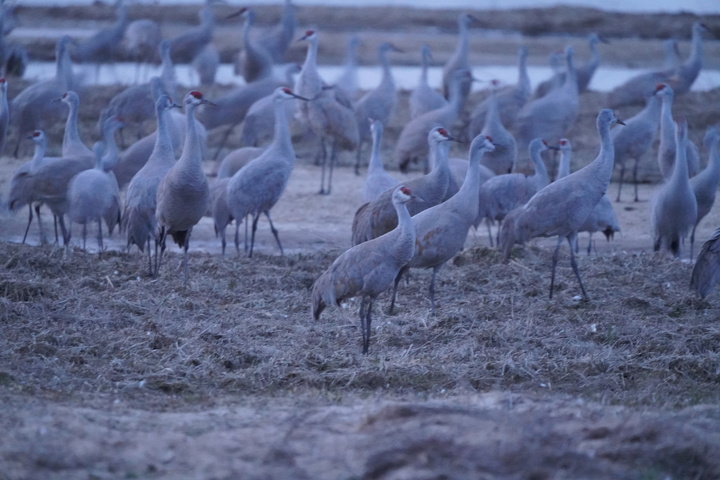
On one bright morning atop Mt. Albright, I was preparing for a ski descent when an ancient noise floated up from the valley floor. It was the unmistakable, 100-decibel vocalization of Sandhill Cranes—drifting up from 4,000 feet below and four linear miles to the east.
The Physics of an Ancient Voice
How does a bird’s voice carry that far? The secret lies in a feat of biological engineering. The convolutions of the trachea, and the cavernous sternal cavity in which it is coiled, are remarkably pronounced in cranes.
The Sandhill Crane possesses a trachea so convoluted and a sternum so deep that its voice functions like a natural French horn. This power passes through the syrinx and into the wild at a frequency perfectly tuned to carry across open landscapes and up to great alpine heights. While swans share a similar anatomy, the crane’s cry is far more complex, guttural, and sonorous.
More Than Just a Noise
Active primarily near the bookends of the day, Sandhill Cranes use these calls for more than just volume. When you hear that rattling bugle at dawn or dusk, you are listening to a sophisticated social language:
Territorial Defense: Warding off rivals from their nesting grounds.
Family Ties: Communicating with their young, known as colts.
The Pair Bond: Signaling the strength of the life-long commitment forged with their partner.
These birds are active listeners, too—capable of identifying specific individuals and distinguishing a trusted neighbor from a wandering stranger. Throughout the spring and summer, their cry is as spellbinding as any in the Greater Yellowstone Ecosystem, rivaling even the mournful howl of the gray wolf.
A Multisensory Way to Wander
As a naturalist guide in these parks, I often see visitors focus entirely on what they can see through a lens. But a trip to Yellowstone or Grand Teton is best experienced when it is multisensory.
If you want a memory that truly sticks, don’t just look. Reach out and feel the sting of icy snowmelt on your feet. Rub a pungent sage leaf between your fingers. Taste the tart explosion of a handful of wild huckleberries, or listen for the rhythmic drum of a sharp-tailed grouse hidden in the timber.
And if you’re lucky, you’ll catch that rattling cry of the Sandhill Crane; a sound that distills and embodies everything wild, ancient, and untamed about this amazing place.


